Why Star Ratings Don’t Tell the Whole Story

The Illusion of “Perfect” Ratings
There’s something off about perfection, especially in business. Scroll through review platforms and you’ll find companies sitting on near-flawless scores, barely a negative word in sight. It looks convincing at first glance, but step back for a second. No company serving real customers at real volume avoids problems. It doesn’t happen. So when you see a wall of five-star reviews with almost no criticism, you’re not looking at reality, you’re looking at a version of it that’s been filtered, curated, and in some cases, carefully managed. Perfection isn’t proof of excellence. More often, it’s a signal to look closer.
Pay-to-Play Is Real—Whether People Like It or Not
The uncomfortable truth is that platforms like Trustpilot and Yelp are not neutral scorekeepers, they’re businesses with revenue models. Trustpilot operates on subscriptions, offering tools that help businesses generate and manage reviews. Yelp sells advertising and enhanced visibility. That alone doesn’t discredit them, but it does introduce influence. When companies can pay for better tools, more exposure, or more control over how feedback is presented, the playing field isn’t level. On top of that, both platforms actively remove massive volumes of reviews every year. They call it moderation, and sometimes it is, but they also openly acknowledge a constant flood of manipulation attempts. That should tell you everything you need to know about how stable these systems really are.
Star Ratings Are a Signal—Not the Truth
The biggest mistake people make is treating a star rating like a final answer. It’s not. It’s a summary built from inputs you don’t fully see, filtered reviews, algorithmic decisions, timing patterns, and sometimes outright manipulation. Research has already shown that online reviews, on their own, are unreliable indicators of true performance. They can be helpful, but only if you understand their limits. A 4.8 doesn’t automatically mean great. A 2.9 doesn’t automatically mean terrible. Without context, those numbers are just numbers, and relying on them blindly is where people get burned.
What Real Longevity Looks Like
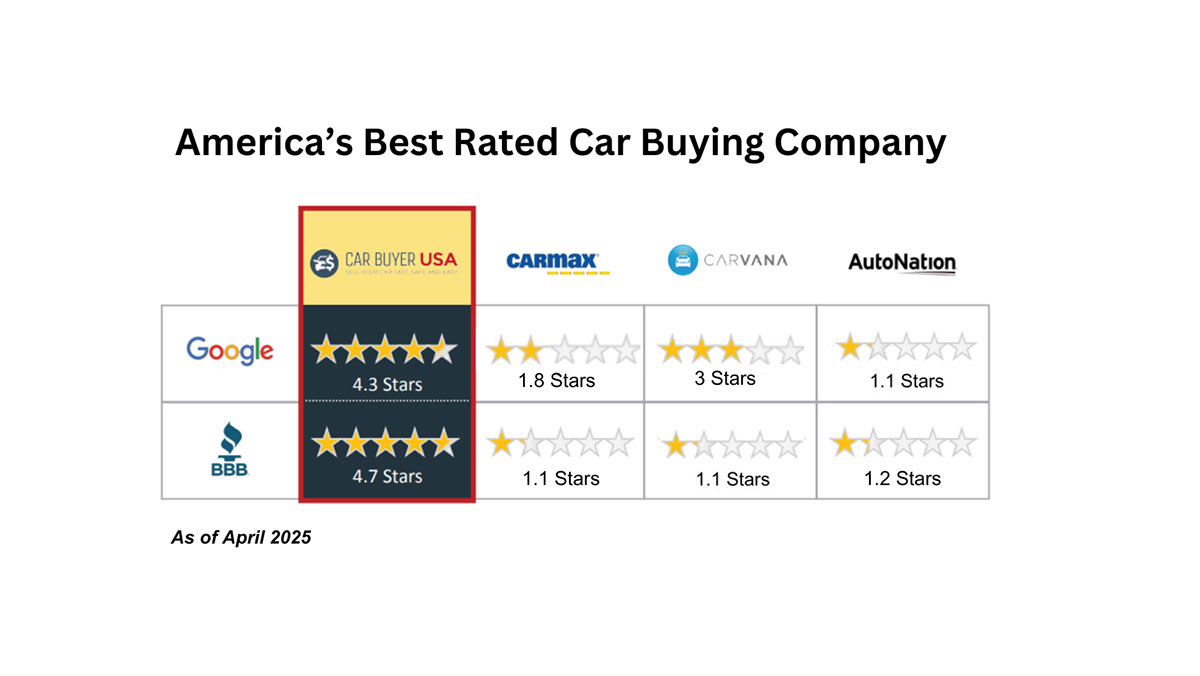
If you want something real, look at consistency over time. CarBuyerUSA.com has been operating for 14 years under the same name! No rebranding, no disappearing acts, no attempts to reset its history. That kind of longevity matters because it means the reputation you’re seeing wasn’t built overnight and can’t be wiped clean with a name change. And when you compare ratings on platforms that don’t rely on the same dynamics, like Google and BBB, you’ll notice something important: They match. A consistent 4.3- star rating and higher, across both, tells a far more honest story than a single inflated score on one platform ever could.
The “Too Perfect” Problem
Here’s the reality most people don’t say out loud, if a company has no 1-star reviews, that’s a red flag. Not because the business is bad, but because the data doesn’t reflect real-world experience. Every company dealing with high volume will have unhappy customers. That’s part of doing business. CarBuyerUSA works with roughly half a million sellers annually, and over 14 years, only a small number of reviews fall into that lowest category. That’s not perfection, that’s proportion. And proportion is what authenticity actually looks like. Real feedback includes both sides, not just the polished version.
American-Owned. American Operated. No Wall Street Strings.
There’s another piece of this that matters more than people realize. CarBuyerUSA is American owned and American operated, no Wall Street, no private equity influence anywhere in the picture. That changes everything. Because when outside investors control a company, priorities shift quickly. Growth targets, margins, and exit strategies start to outweigh customer experience. Here, that pressure doesn’t exist. The business is built and run here, answering to the people it serves, not to a boardroom chasing returns. That “USA USA USA” mindset isn’t just noise. it’s a reflection of how our company actually operates.
The Bottom Line Without Calling It That
Review platforms aren’t useless, but they’re not the truth either. They’re one piece of a much larger puzzle. The smarter move is to compare, question, and look for patterns. Do ratings match across platforms? Does the company have a long, consistent history? Does the feedback look real, or too perfect to believe? Those answers matter more than any star rating ever will. Because at the end of the day, stars don’t tell the story...patterns do.