

Want To Know What Your Car May Be Worth? You Shouldn't Have To Give Up Your Inbox First. You’ve probably experienced it before. You visit a website looking for one simple piece of information, answer several questions and get all the way to the end—only to discover that the answer is sitting behind an email...
Read More
Raleigh is one of those cities where a vehicle can quietly pile on miles without ever feeling like you're taking a particularly long trip. Work in Raleigh but live in Cary, Wake Forest, Garner or Knightdale? That's mileage. Regular trips across the Triangle? More mileage. Add I-40, I-440, I-540 and Capital Boulevard, and an ordinary...
Read More
How Fast Can You Check Your Car's Value Without The VIN? 20 Seconds. Maybe selling your vehicle isn’t the plan yet. You’re simply curious. Perhaps your loan balance has dropped, you’re thinking about buying something newer, or there’s an extra vehicle sitting in the driveway that isn’t getting much use. Before making any decisions, there’s...
Read More
Colorado Springs can make owning the right vehicle feel essential. Mountains, snow, elevation, outdoor recreation and rapidly changing weather practically beg for something capable sitting in the driveway. But there's another side to owning a vehicle here: Colorado Springs can put some serious work on it. Daily driving on I-25, Powers Boulevard and Academy Boulevard...
Read More
Selling a vehicle is usually straightforward. Selling one that belongs to an estate can feel like an entirely different matter. If you've recently lost a family member or are helping settle someone's estate, the car in the driveway may be one more responsibility added to an already long list. You may not know where the...
Read More
Facebook Marketplace and other private-sale platforms have made it incredibly easy to advertise a vehicle. Take a few photos, write a description, choose a price and your car or truck can be in front of thousands of potential buyers within minutes. But there's something sellers can easily forget in the process: You're not just advertising...
Read More
Omaha doesn't give vehicles much of an offseason. A car can spend winter dealing with freezing temperatures, snow, ice and rough roads, only to face Nebraska summer heat a few months later. Add daily commuting, highway miles and another year of normal wear, and suddenly keeping a vehicle “just a little longer” isn't necessarily the...
Read More
YOU CAN COLLECT ESTIMATES ALL DAY. EVENTUALLY, SOMEBODY HAS TO ACTUALLY BUY THE CAR. You decide you're ready to sell your car, so naturally one of the first questions is: What's this thing actually worth? Most sellers start online, and there's nothing wrong with that. KBB, Edmunds and other online valuation tools can be useful...
Read More
Atlanta has a special talent for making a perfectly reasonable distance feel like a road trip. Ask a local how far something is and miles almost become irrelevant. The real questions are: What time are you leaving? Which interstate are you taking? And what happened on I-285 five minutes ago? That's life with a vehicle...
Read More
DON’T HAVE YOUR VIN HANDY? START HERE! You decide to find out what your car is worth, pull up a vehicle valuation site and start answering questions. Year? Easy. Make and model? You know those. Then comes the VIN, and suddenly you're wondering whether you need to walk outside, find your insurance paperwork or squint...
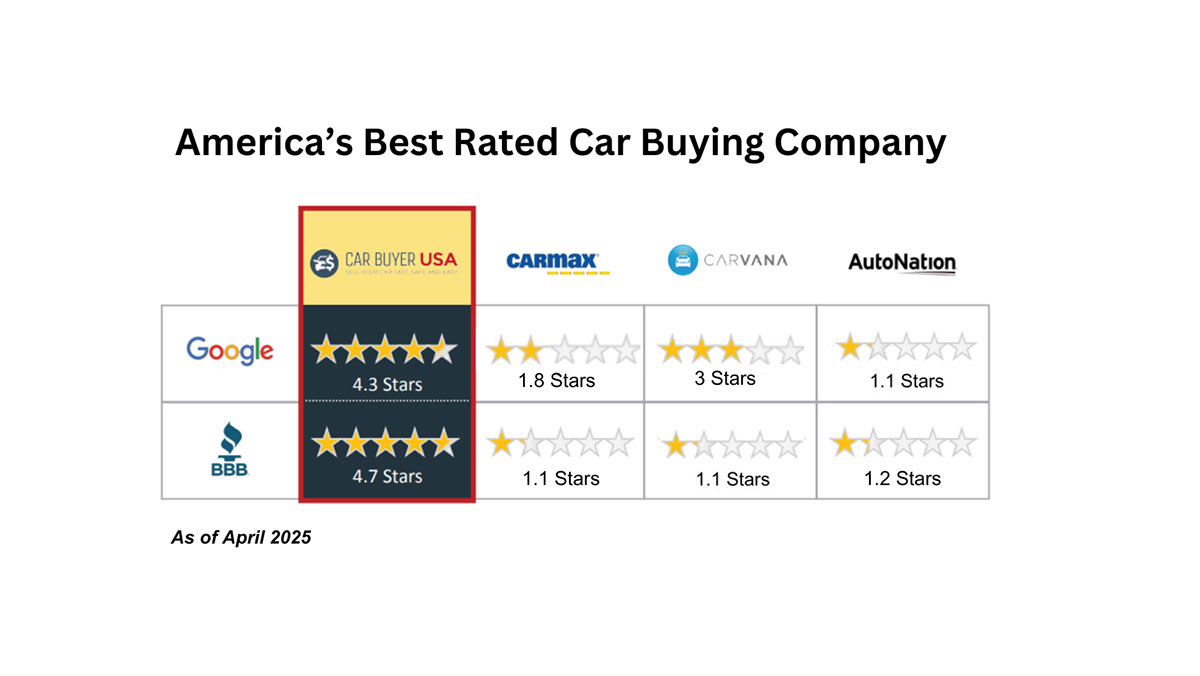
Read MoreCarBuyerUSA's Ratings VS The Big Guys

How It Works
We pay cash for cars, trucks, & SUVs, in any condition, anywhere in the Continental USA.
1
Get an Instant Cash Offer
Enter the Year, Make, Model, Trim Level & Miles (No VIN Required) and your cash offer appears onscreen (94% of the time)
2 Accept your offer
CarBuyerUSA offers are Cash Market Value.
Funds are guaranteed and paid at the time of pickup or drop-off
3Talk to an Agent
Your CarBuyerUSA representative schedules a no obligation inspection. In most markets an on-site mobile inspection can be arranged. The digital purchase agreement takes less than 60 seconds to complete.
4 Get Paid
When CarBuyerUSA picks up your truck, you are paid on the spot in full with guaranteed funds – entire process is hassle free.
Inspection, title work & pick up are all FREE.