
The Slow Death of Selling Your Car Yourself: How The FSBO Deal Has Gone Extinct
Why the "For Sale" sign in the window stopped working, and how technology, market forces, supply chain disruption, and consumer behavior killed it.
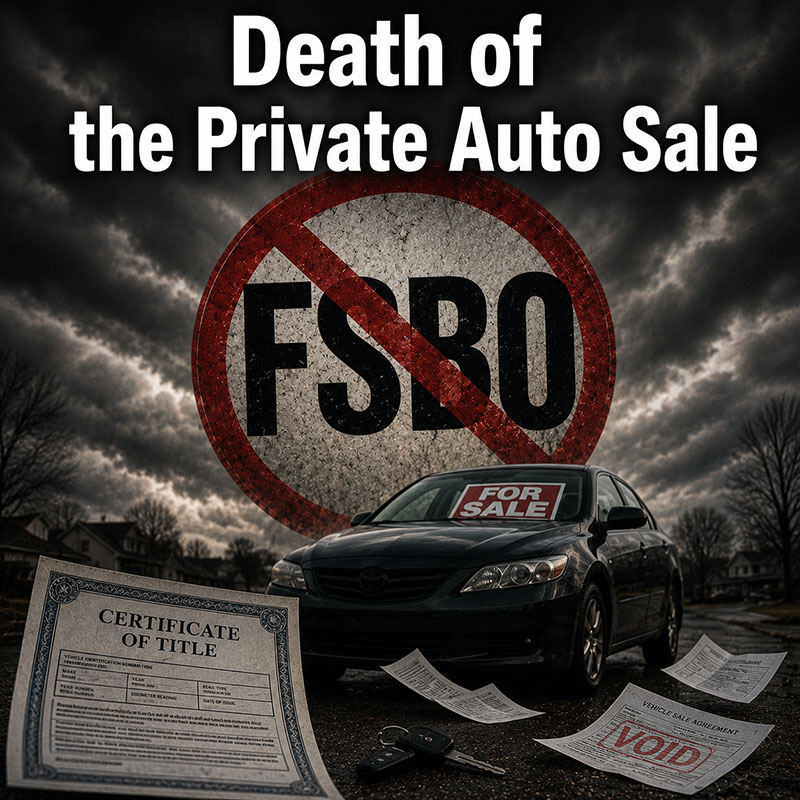
Overview
For most of the last fifty years, selling a used car yourself was simple. You put a sign in the window or an ad in the paper, a buyer showed up with cash, and you handed over the keys. That deal is dying, and not from one cause. Several things are killing it at once. The big car-shopping websites stopped caring about private sellers. The people who still try to sell on their own are usually under some kind of pressure, which makes them easy to take advantage of, and now scammers have cheap tools that used to belong only to pros. A lot of owners owe more on their car loan than the car is worth, so they cannot sell at a fair price even if they want to.
"Facebook Marketplace has become the last refuge of the FSBO seller - and 62% of its users report encountering scams or criminal activity in vehicle transactions."
| Metric | Value |
|---|---|
| Casual used car sales per year | ~10M units |
| FSBO captured by platforms | 5-10% of available listings |
| Average negative equity per trade-in | $7,500 |
Add it all up and the old DIY sale no longer works for a growing share of the roughly 10 million casual car sales that happen in the United States every year. Here is what changed, and where those 10 million cars are going to end up:
1. The Casual Used Car Market
How big it is
By the casual market, we mean regular people selling to regular people. No dealership in the middle. We estimate this is about 10 million cars a year. That sounds small next to the roughly 40 million used cars sold in total, but it is its own world with its own rules, prices, and risks. Dealer sales are organized and regulated. The casual market is the opposite. It is scattered, mostly unregulated, and it swings hard with the economy. People here are not selling because they run a business. They are selling because life made them. Buyers come looking for a deal and accept more risk to get one.
How it changed
The way people buy and sell privately has shifted a lot in ten years, and it sped up after 2020. Roughly:
- Before 2015, it was newspaper ads and Craigslist. Cash deals, older and cheaper cars, and the seller usually knew more than the buyer.
- From 2015 to 2019, more sites popped up and tools like Carfax made a car's history easy to check. Prices climbed. Sellers got more eyes on their cars but also more questions.
- From 2020 to 2022, the pandemic broke supply chains and used-car prices hit record highs. Private sellers found buyers fast and often sold above book value. Loans were cheap and easy, which set up the trouble that came next.
- From 2022 to today, rates went up, car values came back down, and prices stayed high. Now sellers own cars worth less than they paid, buyers cannot afford the financing, and the casual market has mostly stalled.
What different cars look like
| Price | Typical car | What the deal is like |
|---|---|---|
| Under $5,000 | High-mileage, older models | Cash only, sold as-is, often skipped maintenance. The most scam-prone tier. |
| $5,000 to $15,000 | Five to twelve years old, mainstream brands | Mix of cash and loans. Owing more than the car is worth is common. The busiest tier. |
| $15,000 to $30,000 | Newer, lower miles | A loan is almost always needed. Tight credit shrinks the buyer pool. |
| Over $30,000 | Trucks, luxury, late-model | Private sales are rare. Buyers want dealer-level protection, and dealers compete hard. |
The loan problem: owing more than the car is worth
The biggest change since the pandemic is how many people owe more on their loan than their car is now worth. The industry word for this is negative equity. The plain version: you bought high, the car dropped in value, and the loan did not. During the 2020 to 2022 spike, people paid inflated prices and stretched their loans out to 72 or even 84 months to keep the payment down. Then values came back to earth. The result is rough.
- We estimate the average trade-in now carries about $7,500 in negative equity.
- If you are in that spot, you cannot sell privately at market price unless you bring cash to cover the gap. Most people can't, or won't.
- That leaves three options: keep the car, trade it in at a dealer who rolls the shortfall into a new loan, or default.
- A private sale gives you no way to absorb that gap. So for millions of would-be sellers, it is simply off the table.
2. The people in this market
Most private sellers are under pressure
People who sell their own car are usually doing it because something forced their hand. Money, a mechanical problem, or a life change. That pressure is the reason the private market is so shaky. The main groups we see:
- The car has a problem. A failing transmission, deferred repairs, or ugly body damage makes a dealer trade-in a bad deal, so the owner hopes a private buyer will take the gamble.
- The owner needs cash now. When you need money fast, you stop holding out for the best price. Scammers know this and go after these sellers first.
- A life change hit. Divorce, a death in the family, a new disability. These sellers are motivated and often not experienced, which makes them vulnerable.
- The car no longer fits. A bigger family, a move, retirement. Less desperate, but still trying to skip the dealer and keep more money.
- A new driver needs wheels. A teenager gets a license, a kid heads to college. These buyers usually have thin credit and shop under $10,000.
Almost everyone wants to avoid the dealer
One thing we see again and again: people really do not want to deal with a dealership. Buyers and sellers both.
- Sellers think they will pocket more selling on their own than trading in. They are often right.
- Buyers think they will pay less buying private than buying off a lot. They are often right too.
- Both sides distrust the back-and-forth at a dealership: the add-ons, the lowball trade offer, the prices that change depending on who is asking.
That distrust is strong enough to push people into deals they are not ready to handle safely, right as the tools that used to protect private sellers have disappeared.
Everyone wants it done today
People expect everything fast now, and car deals are no exception. Private buyers and sellers increasingly want:
- The deal closed the same day or the next.
- To pay by Venmo, Zelle, or Cash App instead of a cashier's check or a wire.
- To see the car over a video call instead of driving across town. The catch is that none of them are sure how the title actually transfers. That rush is exactly what scams are built to exploit. The classic tricks, fake escrow, overpayment, and title washing, all depend on one side moving faster than good sense allows.
Buyers cannot get a loan
Higher interest rates have choked off financing for private buyers, especially in the middle of the market.
- Banks and credit unions have tightened up on private-party auto loans because they default more often than dealer loans.
- A lot of buyers looking in the $10,000 to $25,000 range cannot get a loan at all through normal channels, which pushes them to buy-here-pay-here lots or out of the market.
- There is no dealer-style financing arm to lean on, so even fair deals between motivated people fall apart.
- Cash buyers used to keep this market moving. Inflation ate into savings, so there are fewer of them now.
3. The technology working against you
Artificial intelligence
Scamming used to be easy to spot. Bad grammar, a story that made no sense. AI changed that. The con is more professional now.
- AI writes clean, believable listings and messages. The old red flags are gone.
- Voice tools let a fake buyer or seller hold a normal phone conversation, so scams run by phone at scale.
- Image tools let a fraudster match stolen photos to a real VIN, so a fake listing looks consistent.
- AI can sort through listings to find the most stressed, most eager people and target them first.
Cheap printers that look professional
High-end printing used to require special access. Now anyone can buy a sharp printer and find templates online. That created a forgery problem in car sales.
- Titles, odometer statements, lien releases, and dealer paperwork can be faked at near-perfect quality. Many states still use documents designed to beat 1990s copiers.
- You usually cannot tell a real state title from a good fake by looking at it.
- Sellers face the flip side: counterfeit cashier's checks and money orders that look real.
- The same tools make title washing easier, where a salvage or flood history gets hidden by re-registering the car across states until a clean title appears.
Companies that sell your personal information
Data brokers have made it cheap to buy details about almost anyone, and scammers use those details to sound legitimate.
- Your address history, phone numbers, and family names can be bought for a few dollars. Drop one real detail into a message and a stranger suddenly seems trustworthy.
- Where registration data is available, a scammer can find owners of a specific make and model and go straight at them.
- Social media fills in the rest: your job, your money stress, your relationship status, all used to tailor the pitch.
4. Where the marketplaces went
The big car sites left private sellers behind
The major car-shopping sites like Cars.com, AutoTrader, TrueCar, Carfax, Edmunds, and the rest, made a clear choice. They turned toward dealers and away from private sellers.
- Dealers pay subscriptions and sign data deals. A private seller pays a small listing fee at most, and brings no repeat business.
- Together these sites capture maybe 5 to 10 percent of private listings, by our estimate. That is not a scale problem. It is a choice.
- Their search results push dealer cars to the top, because dealer inventory is updated more often and tagged with cleaner data.
- All the trust tools they built, history reports, price guides, financing links, were built for dealer sales. They do little for a private deal.
So the private seller got pushed off the busiest, most trusted sites and toward the sketchier corners of the internet.
Facebook Marketplace is where everyone landed
With the big sites gone, Facebook Marketplace became the default place to sell a car privately. It is huge and free to post. It has also been rough on the people using it.
| The pitch | The reality for private sellers |
|---|---|
| Free to post | No identity checks, no accountability, no recourse when a deal goes bad. |
| Cheap for dealers too | Dealers post the same car several times to game exposure without paying for it. |
| Massive reach | That reach includes the largest pool of bad actors in car sales anywhere. |
| Easy to report scams | Reported listings often stay up for days. Enforcement is slow and uneven. |
In our own sampling, around 62% of Marketplace users said they ran into a scam or shady activity while trying to buy or sell a vehicle. Facebook Marketplace did not fix the private market. It just soaked up everyone the other sites dropped, without giving them any of the safety or trust they needed.
The economy made the cars worse
Inflation and its aftermath hit the private market three ways.
- Skipped maintenance. When budgets got tight, people put off oil changes, brakes, and tires. So the private market now has more cars with hidden mechanical problems, and informed buyers want a discount for the risk.
- More wear and tear. People are keeping cars longer and driving them more, so private cars show more miles, worn seats, and faded paint. That drops the price and stretches out how long they take to sell.
- The loan gap again. With about $7,500 in negative equity on the average trade-in, a seller with a $12,000 car and a $19,500 loan has to find a buyer willing to take over the loan, bring $7,500 in cash, or walk away. As values keep settling and balances stay put, the gap is getting wider, not smaller.
5. What replaces it
The private sale is not just slowing down. It is being squeezed out by all of this at once: the sites that left, the buyers and sellers who got vulnerable, the scam tech, and the loan math. Those 10 million sales a year will not vanish. They will move to whoever can handle the mess that a regular person no longer can. We see three places they go.
Dealers win by default
Dealers come out ahead, not because they got better, but because they are the only ones who can swallow the problems. They can roll negative equity into a new loan. They can take a car with issues as a trade. They can arrange financing in-house. They can deal with title messes through their DMV contacts. The person who cannot close a private sale, stuck with a $7,500 loan gap or a car with frame damage, has nowhere else to go. That is not a win for the customer. It is a market breaking in the dealer's favor.
Instant-cash offers
Carvana, CarMax, and the other instant-offer buyers are the fastest-growing place stressed sellers go, especially in the $10,000 to $25,000 range where speed matters most. They give the seller what they want, a clean deal with no danger, but it costs you. Sellers usually leave somewhere around $1,500 to $3,500 on the table versus what a private sale might bring. For someone who cannot spare the time, risk, or hassle of finding a real private buyer, that discount is the price of being safe and done. As their pricing gets sharper, this channel will keep growing.
A better platform, maybe
The hole left by the private market is big enough that someone will try to build a real replacement. A credible one would need ID checks as strict as a bank's, built-in escrow so nobody gets robbed on payment, financing partners willing to fund private deals, and AI that catches scams in the listing instead of after the money is gone. Nobody has put all of that together at scale yet. The market is big enough and the current options are bad enough that someone will keep trying. The only question is when.
What a real fix needs
The failures here are not random. They are built into how the market works. Any real replacement has to solve four things or it will repeat the same mistakes.
- Verified identity. Almost every scam depends on the other person being anonymous. Require a government ID, tie people to a real payment account, and keep a reputation history, and most fraud has nowhere to hide. Airbnb and gig apps already do this. Car sales just never did.
- Escrow for the money. The payment step is where people get burned. Cash is dangerous to carry, Zelle and Venmo cannot be reversed, and cashier's checks are easy to fake. Hold the money until the title actually transfers and both sides are protected. The tech is simple. Getting people to use it, and a company willing to hold the funds, is the hard part.
- Loans for private buyers. This is the most damaging gap. Without financing for private deals, the busiest tier of the market is out of reach for anyone who cannot pay cash. It takes a bank partner willing to fund private sales, or a platform that lends on its own. A few fintech startups are poking at it. None is big enough to matter yet.
- Help with the title. The title transfer is the part most people get wrong, and mistakes can haunt a buyer for years. A platform that confirms the loan is paid off, plugs into the DMV, and flags a salvage or flood or odometer problem before the deal closes would remove the worst legal risk. States are slowly moving to electronic titles, and whoever connects to those systems first will have a real edge.
What this means for dealers
Dealers should not mistake a lucky break for a lasting one. The same forces wrecking the private market are coming for them too.
- Taking in underwater trades means taking on risk. As loan terms stretch and high-mileage cars depreciate faster, that risk piles up.
- Dealers who actually build trust, with upfront pricing, digital paperwork, and a no-pressure finance office, will keep the customers who tried the private market, got burned, and decided the dealer was the safer bet.
- The instant-offer companies are chasing the same cheap trade-ins dealers count on for profit. As their pricing gets better and more sellers know about them, dealers who depend on lowball trades will see those margins shrink.
The person who gets left behind
The biggest cost here is not about business. It is about people. At its best, the private market was a way for regular people to help each other: a seller got full value for a car they no longer needed, and a buyer got reliable transportation for less than retail. That is breaking down. The seller who used to clear $3,000 to $5,000 more than a trade-in now takes an instant-offer haircut to stay safe, or gets nothing because the loan gap freezes them. The buyer who used to find a solid car for $8,000 now wades through scams and beat-up cars, then hits a wall on financing that pushes them toward a buy-here-pay-here lot at 24 percent. These are not abstract problems. For a family selling a paid-off car to cover a surprise bill, that $3,000 difference is real money. For a first-generation college student trying to buy a reliable $8,000 car, being shut out of a loan can mean no way to get to work. The person who once sold a car with a handshake and a sign in the window now faces a process that is harder, riskier, and more expensive than ever. The private market did not fail because people selling to people is a bad idea. It failed because nobody ever built the safety net it needed, and the companies that could have, chose not to. Until that changes, the regular buyer and seller are mostly on their own. This report is for general information only. The figures are CarBuyerUSA estimates drawn from our own transactions and public industry data, and should be read as ranges rather than precise statistics.
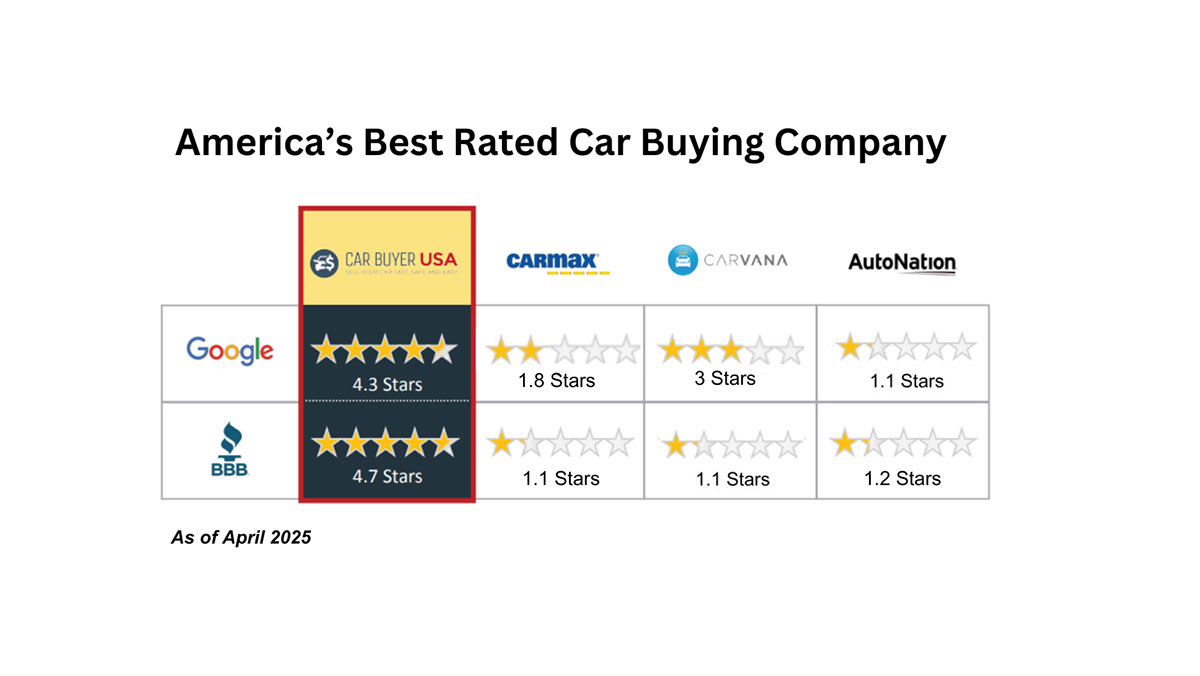
CarBuyerUSA's Ratings VS The Big Guys
How It Works
We pay cash for cars, trucks, & SUVs, in any condition, anywhere in the Continental USA.