
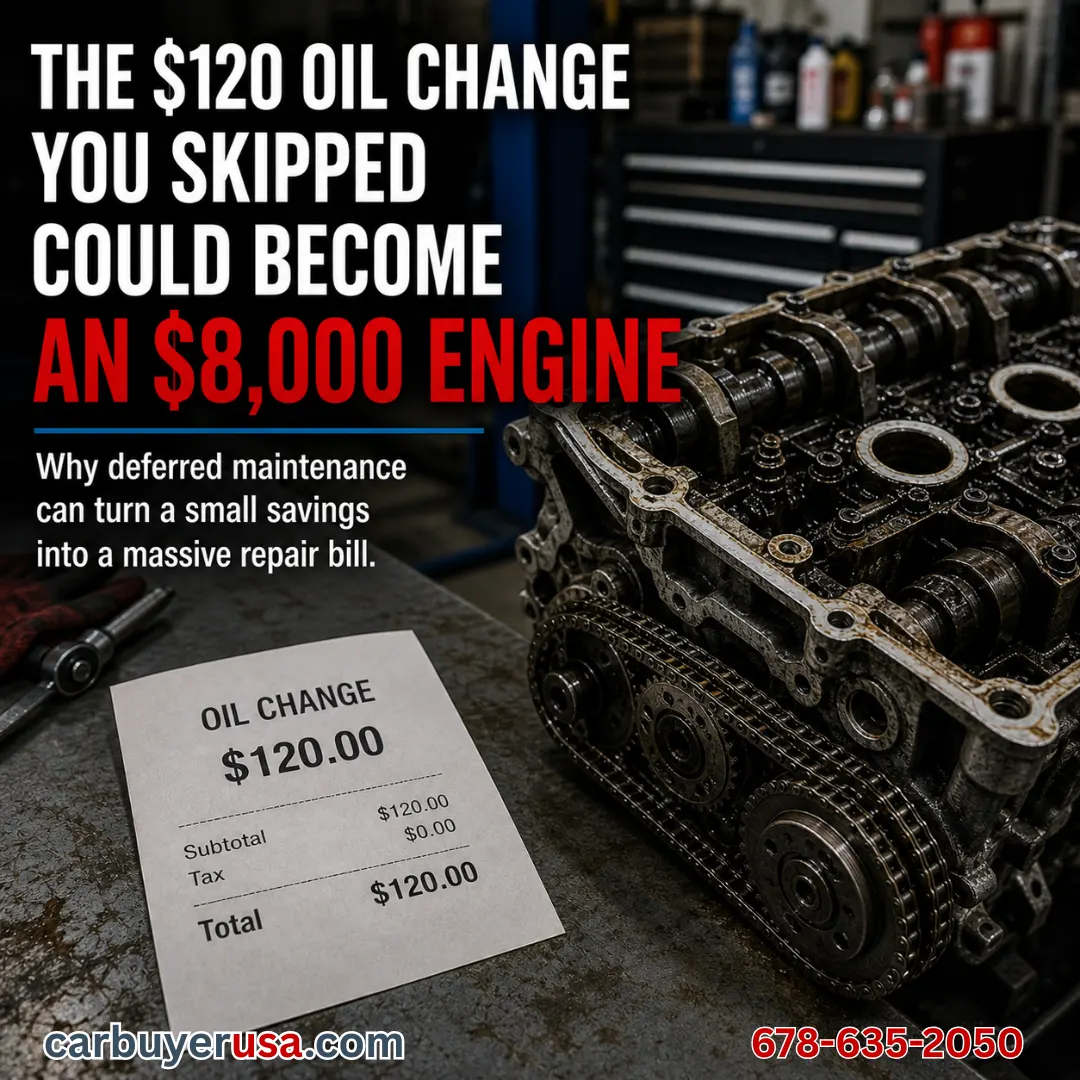
In Part 1, we look at the financial pressure causing Americans to postpone routine vehicle maintenance.
When gasoline, insurance, groceries, utilities and housing are all demanding more money, a $120 oil change can become an expense people convince themselves can wait.
And for a while, it probably can. That's what makes deferred maintenance so dangerous. The vehicle doesn't immediately stop running because an oil change is overdue. There usually isn't a dramatic moment when the engine announces that the owner has crossed an invisible maintenance deadline.
Instead, the miles keep accumulating. Until eventually, putting off a relatively inexpensive service can contribute to a repair costing thousands of dollars.
What's Happening Inside The Engine?
An internal-combustion engine contains components moving thousands of times per minute while operating under tremendous heat and pressure. Motor oil creates a protective layer between many of those components while also helping control heat and carry contaminants through the lubrication system. Fresh oil is specifically formulated to perform those jobs under demanding conditions.
But it doesn't remain fresh forever. Heat, contamination, combustion byproducts and normal engine operation gradually change the condition of the oil and reduce the effectiveness of the additives formulated into it. When oil remains in service far beyond the vehicle manufacturer's recommended interval, deposits and sludge can become increasingly serious concerns.
That's when an overdue maintenance item can begin becoming a mechanical problem.
Engine Damage Usually Doesn't Arrive With A Countdown Clock
This is what makes the situation particularly difficult for financially stressed drivers. An overdue oil change may not cause any immediate symptoms, and the vehicle can continue running normally for thousands of miles with no obvious indication that damage may be developing internally.
But excessive contamination and sludge can interfere with proper lubrication. Increased friction means increased wear and additional heat. Oil passages can become restricted. Internal components that depend on consistent lubrication can begin suffering damage.
Eventually the driver may encounter warning lights, unusual engine noises, overheating, reduced performance, excessive oil consumption or other symptoms. By then, the inexpensive part of the story may be over.
$120 Maintenance Versus A Four-Figure Repair
The financial difference between routine maintenance and major engine repair can be enormous.
Situation |
Approximate Cost |
|---|---|
Typical oil change in major cities |
About $120 |
Significant internal engine repair |
Potentially thousands |
Rebuilt/remanufactured engine |
Several thousand dollars |
Complete engine replacement |
Can approach or exceed $10,000 |
Actual engine repair and replacement prices vary tremendously. A common four-cylinder economy car and a large luxury SUV don't have remotely identical engine costs. Labor rates, vehicle design, parts availability and whether the replacement engine is used, rebuilt, remanufactured or new can change the bill by thousands of dollars.
But that's precisely the problem. A driver who struggled to find $120 for preventive maintenance may suddenly be facing a repair bill of several thousand dollars.
Where is that money supposed to come from?
When The Engine Costs More Than The Car Makes Sense To Repair
Engine failure doesn't automatically mean a vehicle is finished. If the car is relatively new, valuable and otherwise in excellent condition, repairing or replacing the engine may still make financial sense. With an older, higher-mileage vehicle, however, the numbers can change dramatically.
When an aging car suddenly needs thousands of dollars in engine work, the repair cost has to be weighed against what the vehicle will actually be worth afterward. Spending $6,000 on an engine doesn't automatically add $6,000 to the car's value. That's when the owner faces a much bigger decision: repair it, replace it or sell it as-is.
The Real Price Of Deferred Maintenance
This isn't about blaming people for failing to take care of their cars. The financial pressure behind deferred maintenance is real.
When a household has limited money, today's necessities usually win. Gasoline keeps the vehicle moving. Groceries feed the family. Housing keeps a roof overhead. An oil change can seem like something that can safely be pushed into the future.
Sometimes it can. But repeatedly postponing required maintenance doesn't eliminate its cost. It increases the possibility that a predictable maintenance expense eventually becomes an unpredictable repair.
And that's the cruelest part of the entire equation. The driver who couldn't comfortably afford the oil change may be the driver least able to survive the engine repair that follows.
That $120 oil change looked expensive when money was tight.
Compared with replacing an engine, it was the bargain.