YOU KNOW WHAT YOU PAID FOR YOUR CAR. SO WHY IS IT WORTH LESS THAN YOU EXPECTED?
You search online, find vehicles resembling yours, and discover asking prices thousands of dollars higher than the valuation you've received. Frustrating? Absolutely. But two vehicles with the same year, make, and model can have dramatically different values.
The explanation involves far more than age and mileage. Factory equipment, mechanical condition, accident history, maintenance, and market demand all influence what buyers are willing to pay.
Your Trim Level Can Make a Major Difference!
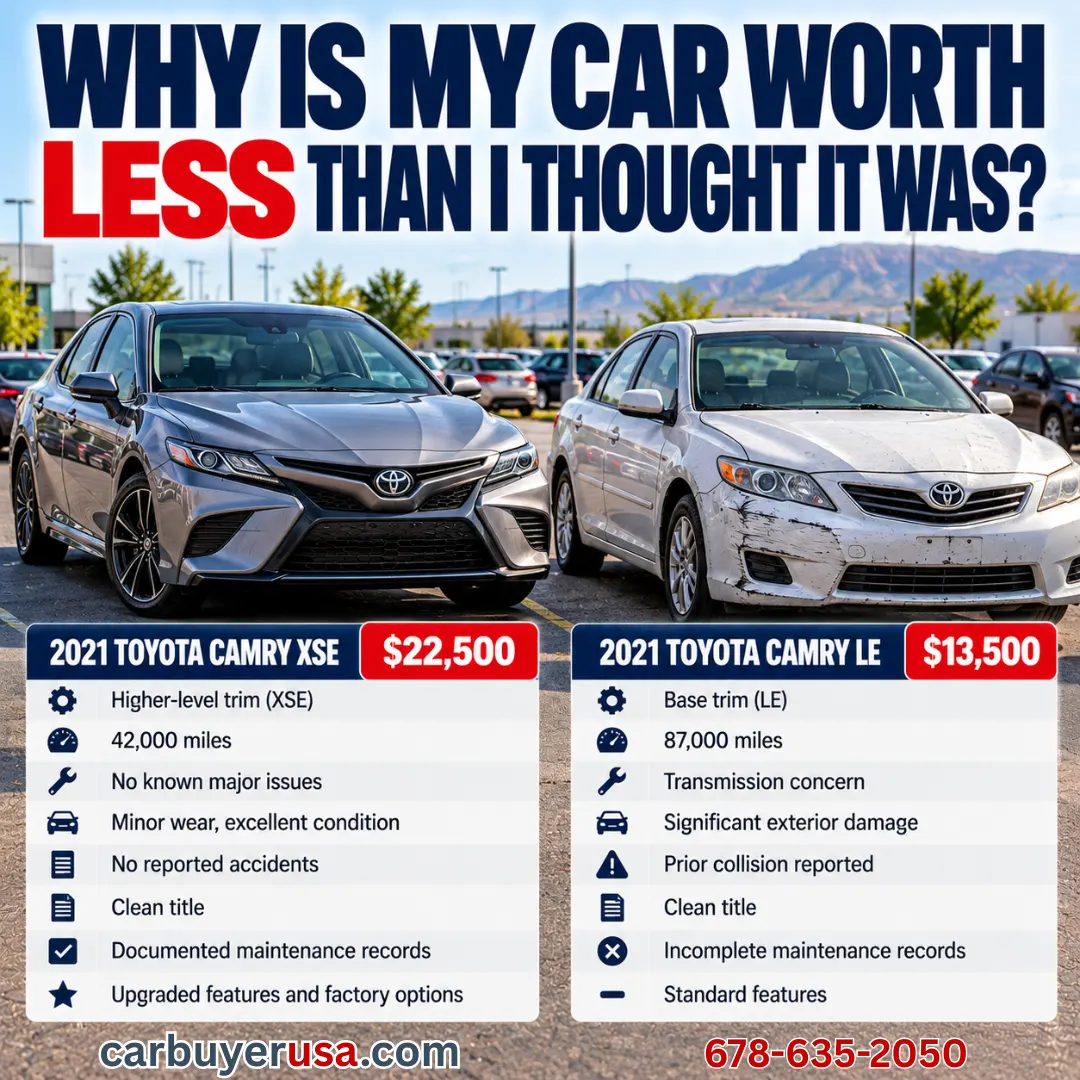
Consider two 2021 Toyota Camrys. One is a base LE; the other is an XSE with upgraded equipment, styling, and potentially a different powertrain. Although both are Camrys, they're not equivalent vehicles. Higher trims may command stronger resale values because of desirable factory features, including premium upholstery, advanced safety technology, upgraded audio, or enhanced performance. However, a $5,000 difference in original sticker price doesn't guarantee $5,000 in additional resale value. Options depreciate differently, and their worth depends on buyer demand. Factory packages matter, too. Even vehicles sharing the same trim designation may have different equipment and valuations.
Mechanical Condition Can Change Everything!
A beautiful exterior doesn't guarantee a healthy engine or transmission. Worn tires, warning lights, failing air conditioning, damaged upholstery, malfunctioning electronics, and mechanical problems can reduce value.
Professional buyers consider potential repairs, reconditioning expenses, and the risk of additional defects. However, repair estimates aren't necessarily deducted dollar for dollar. Their impact depends on the vehicle's overall market value and condition.
Mileage matters because it reflects usage and potential wear. A vehicle with 40,000 miles generally competes in a different market segment than an otherwise similar vehicle with 140,000 miles.
How Different Can Two Vehicle Values Be?
Consider these hypothetical examples involving the same year, make, and model.
Valuation Factor |
Vehicle A |
Vehicle B |
|---|---|---|
Trim |
Higher-level |
Base |
Mileage |
42,000 |
87,000 |
Mechanical condition |
No known major issues |
Transmission concern |
Exterior |
Minor wear |
Significant damage |
Accident history |
None reported |
Prior collision reported |
Title |
Clean |
Clean |
Illustrative value |
$22,500 |
$13,500 |
These hypothetical figures illustrate how multiple differences can influence value. They are not actual appraisals or published market statistics.
Accident History and Title Brands Aren't the Same!
A vehicle can have a clean title and still have a reported accident. A clean title doesn't certify an accident-free history. Minor cosmetic repairs generally raise different concerns than structural damage or deployed airbags.
Salvage and rebuilt titles introduce additional considerations involving previous damage, repair quality, insurance, financing, and future resale demand. These distinctions can significantly affect what buyers will offer.
Does Location Affect Your Car's Value?
Absolutely.Regional demand, competing inventory, fuel prices, and seasonal preferences influence valuations. All-wheel-drive vehicles may attract stronger interest in snowy climates, while fuel-efficient vehicles may appeal to commuters elsewhere. Even color can affect desirability, depending on the model.
And remember: an advertised asking price isn't an actual completed sale. Retail listings may also reflect expenses and profit margins that aren't part of a vehicle's direct-purchase value.
What About Maintenance and Expensive Upgrades?
Routine maintenance protects your vehicle's condition but doesn't necessarily increase its value by the amount spent.
New brakes, tires, and fluid changes often restore expected operating condition rather than create additional resale value. Aftermarket wheels, custom modifications, and performance upgrades can also have limited appeal. Some may actually narrow the pool of interested buyers.
Stop Guessing. Find Out What Your Car Is Actually Worth!
Your vehicle deserves an evaluation based on its specific characteristics, not someone else's online advertisement. CarBuyerUSA purchases vehicles nationwide, considering individual details such as equipment, mileage, condition, and history. You can begin exploring your vehicle's potential value online in 20 seconds, without providing your name, email address, phone number, or VIN.
CarBuyerUSA also arranges vehicle pickup, helping sellers avoid the inconvenience of advertising privately and coordinating meetings with strangers.
BEFORE YOU ACCEPT LESS, SPEND MONEY ON REPAIRS, OR ASSUME YOUR CAR ISN'T
WORTH SELLING, GIVE CARBUYERUSA THE OPPORTUNITY TO EVALUATE IT!
Visit CarBuyerUSA.com and find out what your particular vehicle could bring in today's market. Your car isn't identical to every other one advertised online. Its value shouldn't be treated that way!